Exciting open-source projects for e-ink
From OpenDisplay and Tesserae to a self-built e-reader: these projects show how versatile open e-paper technology can be.
Here’s a look beyond our own project at other open e-paper projects that are out there.
OpenDisplay: An open foundation for your own displays
Anyone who wants to use an e-paper display for their own idea needs a way to transfer content to it. This is where OpenDisplay comes in: the project develops an open standard, firmware, and tools for displays that are controlled via Bluetooth Low Energy.
Various platforms based on nRF52840 and ESP32 are supported. Via the web tools, suitable devices can be flashed with firmware, configured, and loaded with images. The firmware is licensed under GPL-3.0.
What’s particularly exciting is that a shared technical foundation is emerging for different devices. On top of this, people can build their own displays and applications without having to start from scratch every single time.
Discover OpenDisplay · Firmware on GitHub
Tesserae: Designing your own dashboard
What should actually be shown on the display? Tesserae tackles exactly this question. In the browser you can compose pages from widgets, text, and shapes. Weather, calendar, Home Assistant, or departure information can all be brought together in one place this way.
The software prepares the content for the respective display and then updates it on a schedule. It is licensed under AGPL-3.0, and a large number of different devices and display platforms are supported.
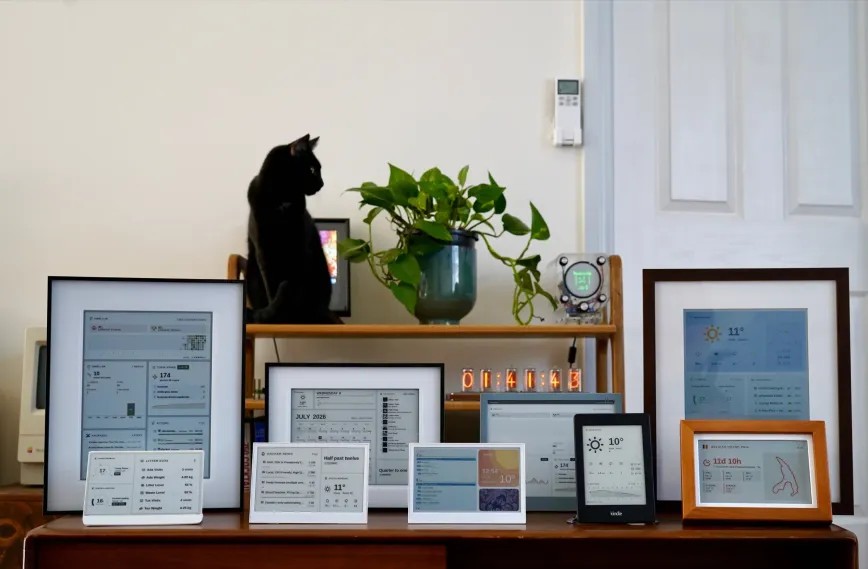 Tesserae bringt unterschiedliche Dashboards auf verschiedene E-Ink-Geräte. Foto: Tesserae (tesserae.ink).
OpenEPaperLink: New tasks for electronic price tags
Those small electronic price tags from the supermarket can do more than show prices. OpenEPaperLink has for quite some time been developing alternative firmware and a communication protocol that lets you supply supported e-paper tags with your own content.
The project includes software for the displays and the access point as well as designs for access points and controllers.
What’s great is that existing technology is given a new task. A suitable price tag could, for example, become a small status display or a changeable label for the workshop.
Inkplate: A platform for your own e-paper ideas
Inkplate from Soldered combines e-paper displays with programmable development boards. On the Inkplate 6, (as with us) an ESP32 and Wi-Fi form the foundation. Hardware documentation and software are openly available, including schematics, PCB manufacturing data, and an Arduino library.
Anyone who wants to program themselves will find a starting point here for their own calendars, information displays, or picture frames. Inkplate takes over part of the electronics work and leaves plenty of room for your own application.
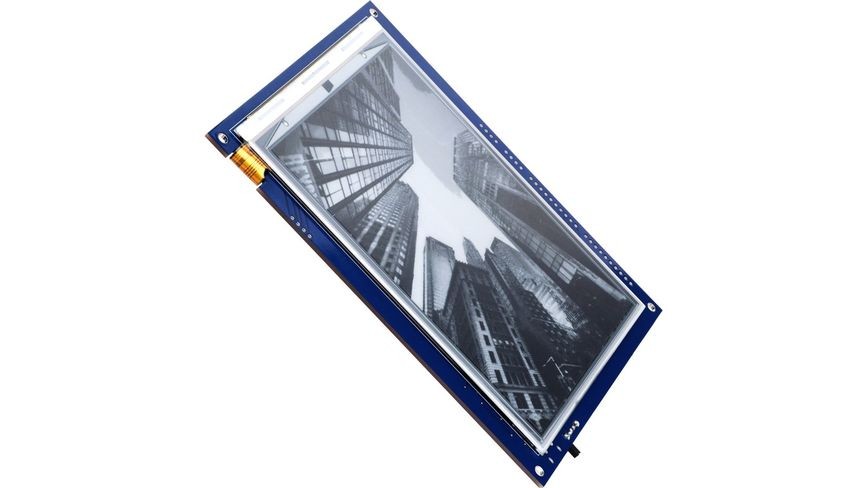 Inkplate 6 kombiniert ein wiederaufbereitetes E-Reader-Display mit einer offenen Entwicklungsplattform. Foto: Soldered Electronics / Crowd Supply.
More about Inkplate 6 and its open development files
TRMNL: Information at a glance
TRMNL is currently probably the best-known e-paper solution and follows the idea of making selected information visible without constantly having to open an app. The project connects displays with various services and prepares their content as clear, concise views.
TRMNL is only partially open source. The firmware and custom guides are open, while the device itself is proprietary.
The Open Book: An e-reader you can understand
A reading device whose construction you can understand and modify: that’s the idea behind The Open Book by Joey Castillo. The project makes developing your own e-reader accessible and publishes the associated designs and software.
This particularly appeals to people who like to build things themselves and want to understand how their device works. The version described in the repository is based on a Raspberry Pi Pico and is designed for a manageable number of components and hand assembly.
Modos: E-paper as a computer monitor
We build devices that take quite a long time before a new image is shown. In contrast, Modos is dealing with a different challenge: how can the technology be used for a responsive computer monitor?
One foundation for this is the open-hardware project Glider together with the open display controller Caster. The focus is on low latency and fast driving of suitable panels. This also gives rise to products like the Modos Paper Dev Kit.
This is technically demanding and all the more interesting for it. Here, work is being done right down to the display driving level to unlock new use cases for e-paper.
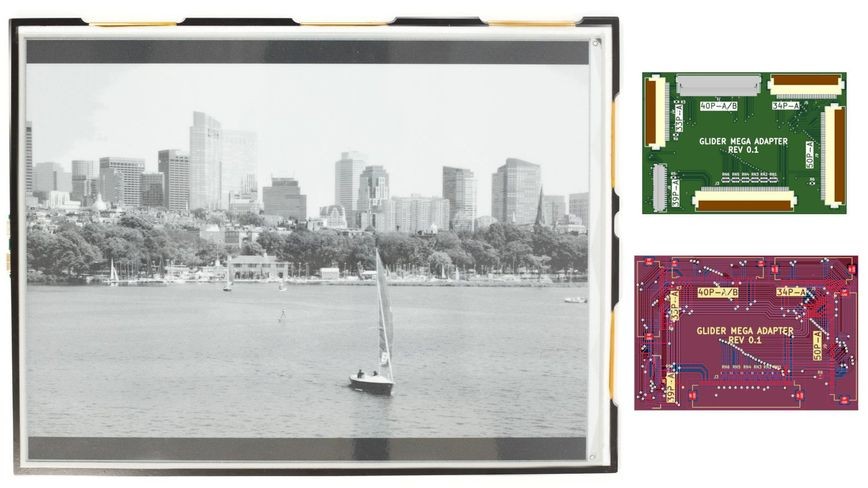 Das Modos Paper Dev Kit erschließt E-Paper als Computermonitor. Hier die 13-Zoll-Variante mit Glider Mega Adapter. Bild: Modos Tech / Crowd Supply.
More about Glider and the Modos projects
Why projects like these are great
These projects show how varied open development can look. Some publish firmware, others a dashboard application or the hardware designs. Anyone who wants to build or modify something themselves should therefore check which parts are actually open and which devices are supported.
In our own OpenPaper, hardware, software, and design files are all part of the open-source approach. We develop and manufacture locally in Dresden, from the frame to final assembly. All the more we’re delighted about other people who share their knowledge and push e-paper forward in their own way.

Content
- OpenDisplay: An open foundation for your own displ...
- Tesserae: Designing your own dashboard
- OpenEPaperLink: New tasks for electronic price tag...
- Inkplate: A platform for your own e-paper ideas
- TRMNL: Information at a glance
- The Open Book: An e-reader you can understand
- Modos: E-paper as a computer monitor
- Why projects like these are great